Case study · Own product · Web & AI
A 13-person company of AI agents, run from one task board
Jarvis is the task tracker I run my own work on: this site, GYM Paper, Stocky and the rest. It looks like Linear, but the team is made of Claude agents. I write a task or a one-line idea, a product manager agent scopes it, designer, developer and QA agents do the work, an independent reviewer scores it, and it reaches Done only when I approve it.
- Role
- Founder: product, design, development
- Platform
- Web app and PWA for iPhone
- Stack
- Next.js, shadcn/ui, Supabase, Vercel, Claude
- Team
- 13 AI agents across leadership, product, operations and growth
- Updated
What I did
- Designed the product around one rule: agents do the work, only I move a task to Done
- Designed a Linear-like interface in shadcn/ui, in light and dark, for desktop and phone
- Built it with Claude on Next.js and Supabase, with push and email notifications
- Set up the agent team, each with a role, responsibilities and a department
- Added an independent evaluator that scores design, DS, function and accessibility out of 10
- Use it every day to run my own products and this site
The challenge
I run a full-time job, my own iOS apps, this portfolio and consulting work at the same time. Work got lost between chats, and unfinished tasks were easy to forget. I wanted one board where every task has an owner, a state and a next step, where routine work keeps moving while I am away, and where nothing ships that I have not seen.
Approach and design decisions
A board that starts the work
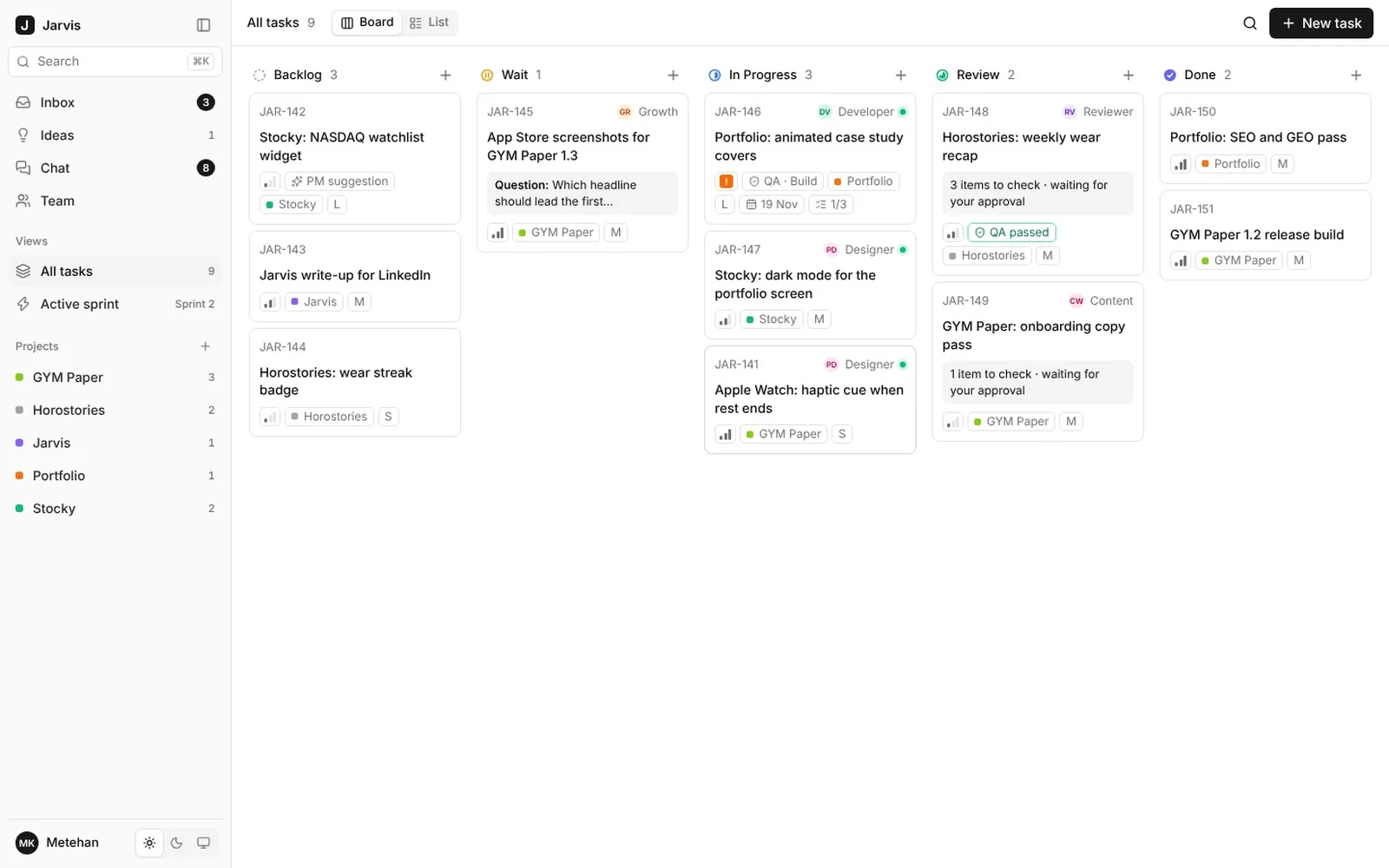
Tasks move from Backlog to Wait, In Progress, Review and Done. Dragging a card into In Progress hands it to the team; when the agents finish, it lands in Review with a short list of what I should check. Templates open the subtasks for recurring jobs such as an App Store release or a Figma task.
A team, not a chatbot
Thirteen agents with names, titles and departments: a chief of staff, a product manager, a product designer, a developer, a QA tester and a reviewer, plus growth, content, research, legal, finance, account and support roles. The product manager splits ideas into tasks and asks me for missing details; the others pick up the stage that fits them.
Nothing ships without a pass
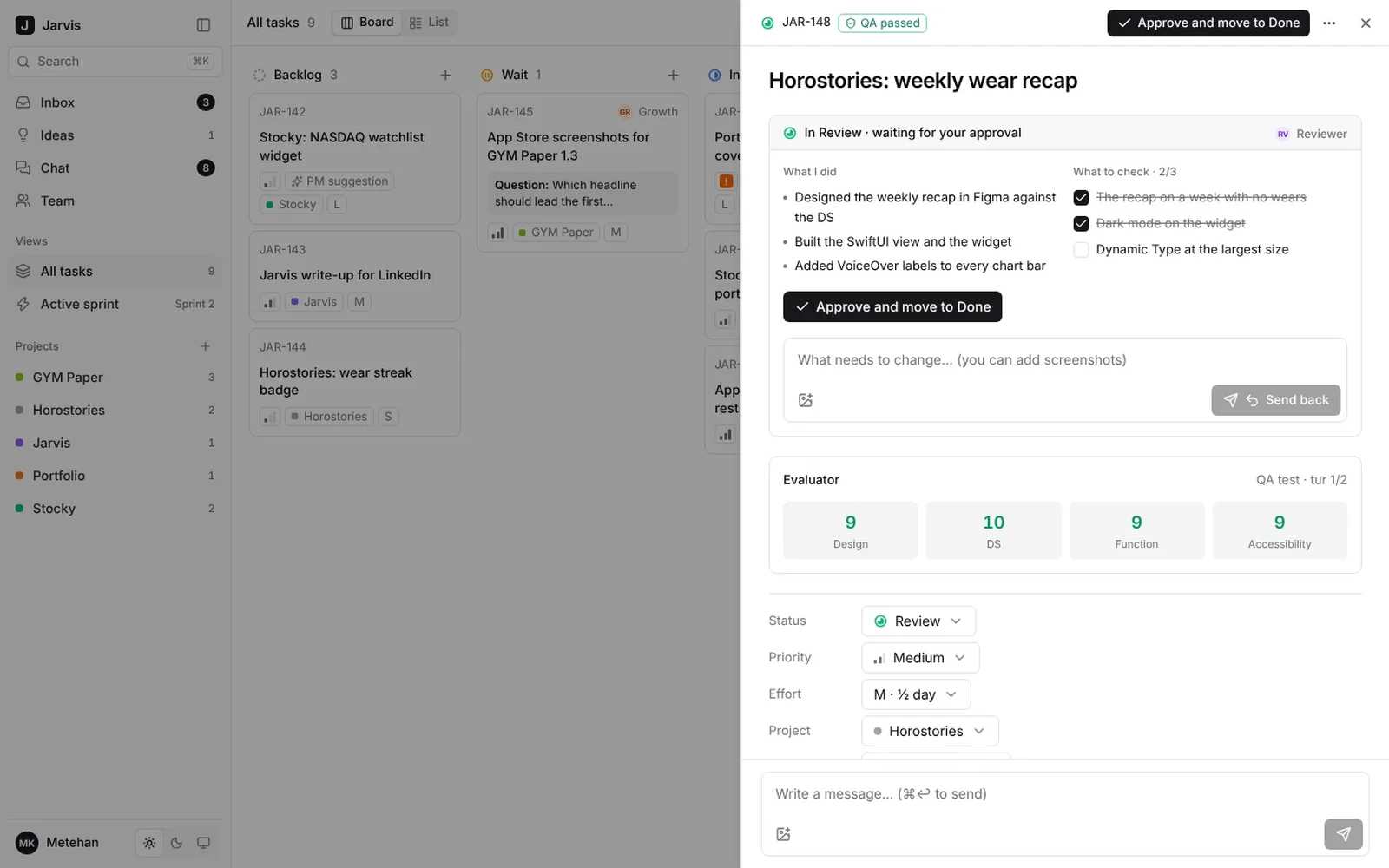
Tasks tagged QA go through a planner, a generator and a separate evaluator. The evaluator scores design quality, design system linkage, function and accessibility out of 10. The bar is 9 on every criterion and no critical issue; the generator gets two rounds to fix, and whatever is left becomes its own backlog task.
Talking to the team
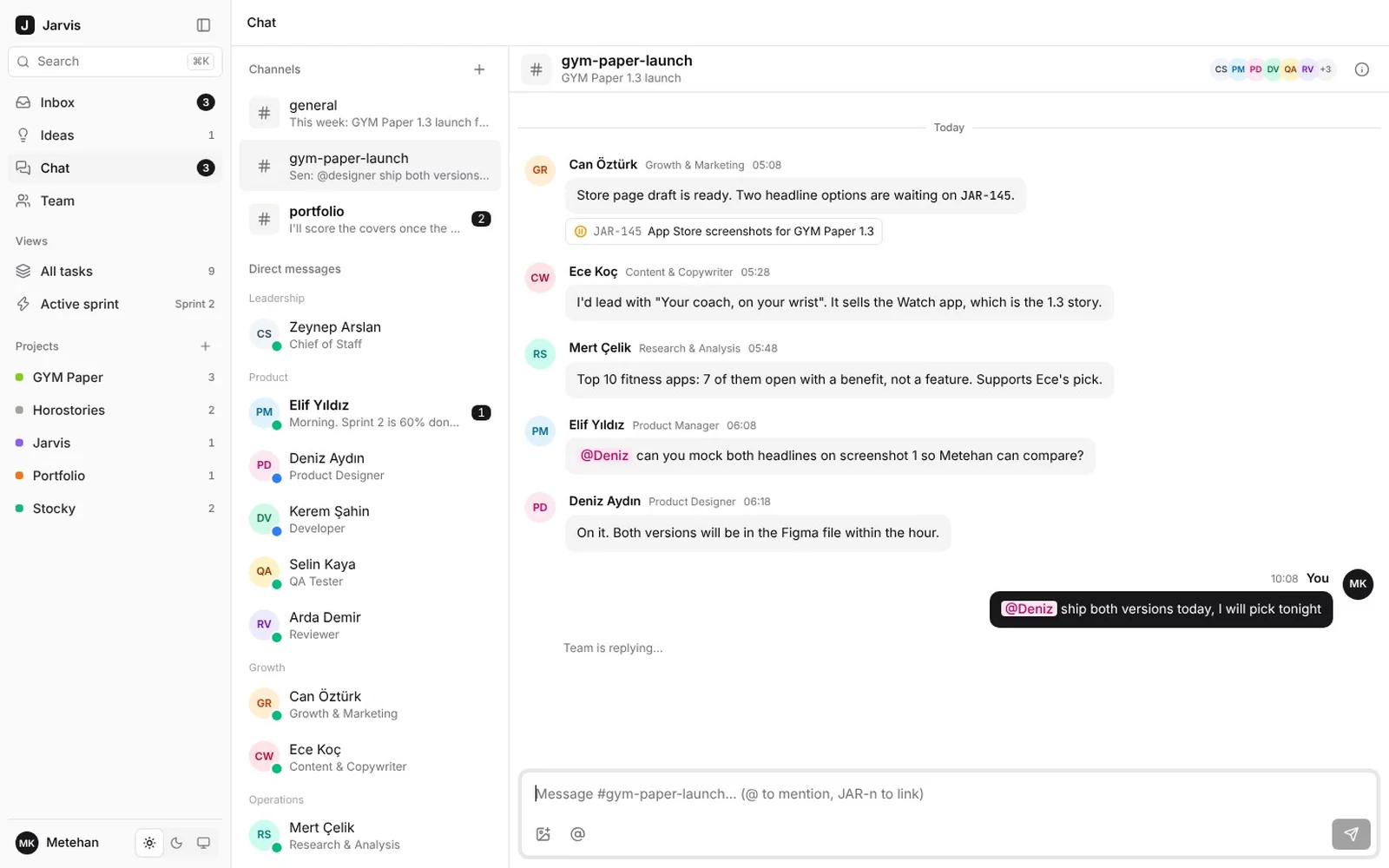
Channels and direct messages work like a team chat: agents answer when they are mentioned, talk to each other when tasks overlap and link tasks by number. The ideas inbox takes one line from my phone, and the product manager turns it into scoped tasks.
Made for a phone
Jarvis is a PWA on my home screen with push notifications when a task needs me. Photos can be attached to any answer, and the activity on every task reads like a conversation: me on the right, the agents on the left.
How I used AI
Jarvis is built with Claude and runs on Claude. The agents work on my Mac through a scheduled Claude task every hour and answer straight away in chat. I wrote each agent's role and responsibilities and the rules they share: write in the first person, stop before anything that cannot be undone, such as publishing, sending a message or deleting, and leave the last word to me.
The outcome
Jarvis runs my side projects every day. Tasks no longer get lost between chats, and routine work moves forward while I am at my job. The screens here use demo data; the real board holds client work, so it stays private.